

Most business owners still treat their websites as glorified brochures, missing incredible growth opportunities. Yet 75% of consumers judge credibility based on website design alone. Your site isn't just informational. It's a strategic asset that drives trust, captures leads, and amplifies every marketing dollar you spend. This guide reveals how to transform your website from static presence into an integrated marketing hub that actively fuels business expansion.
Table of Contents
- Understanding The Business Website's Role: Beyond A Digital Brochure
- How Websites Drive Brand Presence And Customer Engagement
- The Impact Of Website Conversion Optimisation On Business Growth
- Integrating Your Website With Multi-Channel Marketing For Maximum Effect
- Tracking And Measuring Website Effectiveness For Continuous Growth
- Common Misconceptions About Websites And Their Corrective Realities
- Practical Steps To Transform Your Website Into A Growth Engine
- Discover Expert Website Design And Marketing Services
- Frequently Asked Questions
Key takeaways
| Point | Details |
|---|---|
| Websites drive credibility | Consumers judge your business trustworthiness primarily through website design and experience. |
| Conversion optimisation boosts revenue | Improved user experience can increase lead generation by up to 50% and directly impact sales. |
| Integration amplifies marketing impact | Connecting your website with multi-channel campaigns improves return on ad spend by 30%. |
| Analytics enable continuous growth | Tracking key metrics allows you to double high-converting traffic sources within three months. |
| Strategic websites outperform brochures | Active conversion platforms generate measurable business results beyond passive information delivery. |
Understanding the business website's role: beyond a digital brochure
Your website shapes first impressions faster than any sales pitch. 75% of consumers judge credibility based solely on design, making your site the most critical touchpoint in the customer journey. Yet many business owners still underestimate this power, treating websites as digital pamphlets rather than conversion engines.
Modern websites function as dynamic platforms that capture leads, educate prospects, and close sales. They're not optional marketing accessories. They're central command centres for your entire growth strategy. Every marketing channel you invest in ultimately drives traffic back to your site, making it the linchpin of business success.
Common misconceptions hold businesses back:
- Viewing websites as one-time projects rather than evolving assets
- Neglecting regular updates and performance optimisation
- Failing to connect website strategy with broader marketing efforts
- Underestimating the impact of user experience on conversion rates
- Treating web presence as separate from brand credibility
Your competitors who recognise this shift gain measurable advantages. They convert more visitors, retain more customers, and extract greater value from every marketing investment. Your business website strategy determines whether you capture or lose these opportunities.
"A website that doesn't actively convert visitors into customers is leaving money on the table every single day."
The gap between viewing your site as information versus treating it as a growth engine represents the difference between stagnation and expansion. This mindset shift unlocks strategic possibilities that transform business trajectories.
How websites drive brand presence and customer engagement
Consumer behaviour has fundamentally changed how buyers evaluate businesses. 68% of UK consumers start research online, making your website the first and often deciding touchpoint. Before speaking with sales teams or visiting physical locations, prospects judge your credibility through digital presence alone.

Website design directly influences brand perception. Clean navigation, fast load times, and mobile responsiveness signal professionalism and reliability. Poor design triggers immediate distrust, regardless of how excellent your actual products or services are. You lose potential customers before conversations even begin.
Integrating your website with social media creates powerful engagement loops. Businesses that connect these channels see 25% higher engagement rates, as coordinated messaging reinforces brand identity across platforms. Your website becomes the authoritative hub where interested prospects learn deeper details after initial social media exposure.
Websites facilitate critical early-stage customer education:
- Answering common questions before sales conversations
- Showcasing expertise through case studies and content
- Building trust with testimonials and social proof
- Providing transparent pricing and service details
- Enabling self-service research at the prospect's pace
Consistent brand messaging across your site strengthens recognition and recall. When prospects encounter unified design, tone, and value propositions, they develop stronger connections with your business. This consistency differentiates professional brands from amateur operations.
Your digital marketing strategies amplify when anchored by a strong website. Paid ads drive traffic, but your site converts that traffic into customers. Social content generates interest, but your website captures leads. Every channel multiplies effectiveness when it directs engaged audiences to an optimised destination.
User-friendly navigation reduces friction in the buying journey. Clear paths to conversion keep prospects moving forward rather than abandoning in confusion. This seamless experience translates directly into higher engagement metrics and more qualified leads entering your sales pipeline.
The impact of website conversion optimisation on business growth
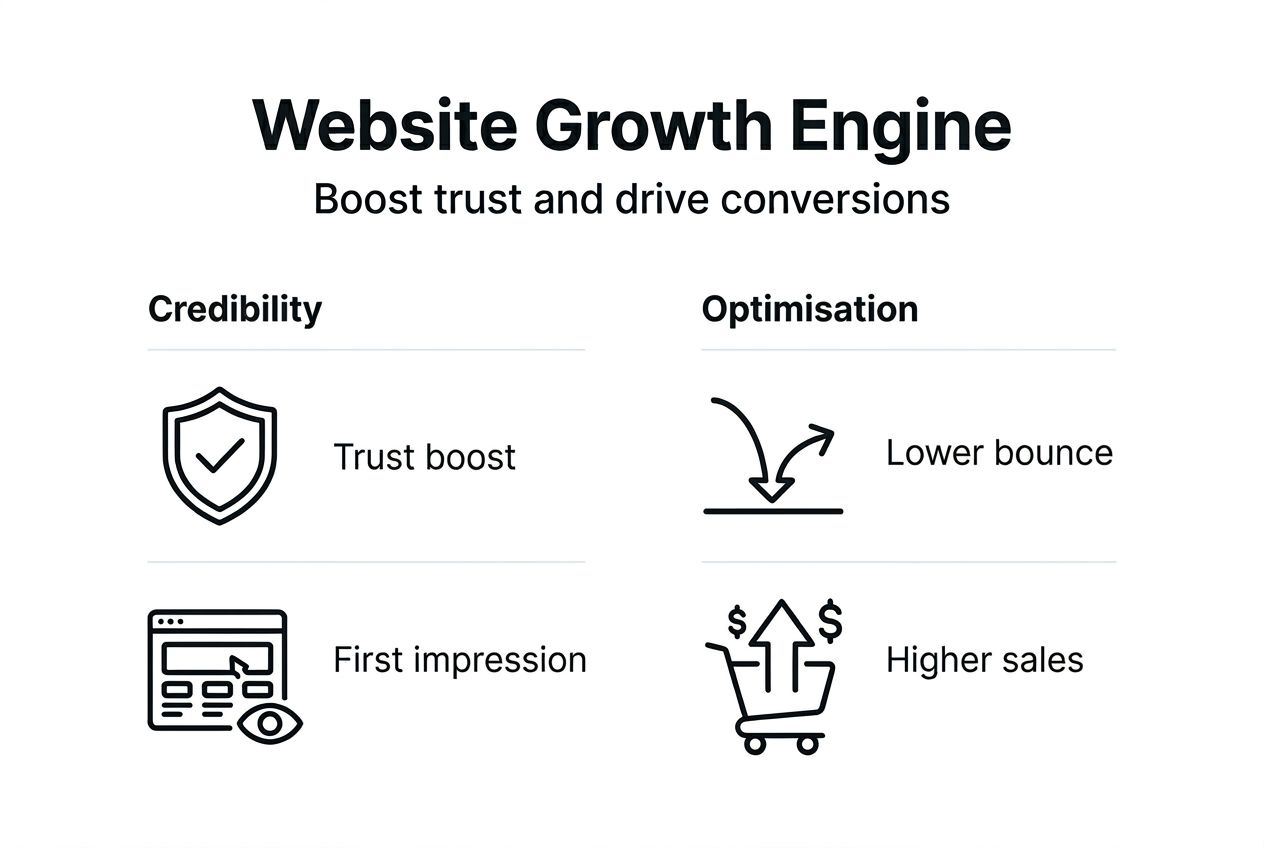
Conversion rate optimisation transforms passive traffic into active revenue. Businesses that prioritise user experience see up to 50% increased lead generation, proving that small improvements yield massive returns. Your website's effectiveness at converting visitors directly determines marketing ROI across every channel.
One UK manufacturing firm revamped their outdated site with streamlined navigation and clearer calls to action. Within six months, they achieved a 40% sales increase without changing their advertising spend. The website became a sales multiplier rather than a bottleneck, demonstrating how conversion optimisation unlocks dormant potential.
Core principles of effective conversion optimisation include:
- Prominent, action-oriented calls to action on every page
- Fast page load times under three seconds
- Mobile-responsive design for seamless smartphone browsing
- Simplified forms that reduce friction in lead capture
- Strategic placement of trust signals like testimonials and certifications
- Clear value propositions that immediately communicate benefits
Updated websites lower bounce rates dramatically. When visitors find what they need quickly, they stay longer and explore deeper. This extended engagement creates more conversion opportunities and signals search engines to rank your site higher, creating a virtuous cycle of increasing visibility.
Your advertising campaigns achieve better results when landing pages align with ad messaging. Generic homepages cause confusion and abandonment. Tailored landing pages that match campaign promises convert traffic at exponentially higher rates, making every advertising dollar work harder.
Pro Tip: Test one conversion element at a time, such as button colour or headline copy, to identify what resonates with your audience. Small, measured changes compound into significant performance improvements.
The shift from viewing websites as brochures to treating them as sales tools fundamentally changes business outcomes. Website design and development that prioritises conversion creates measurable competitive advantages. You capture leads competitors miss and close sales that would otherwise slip away.
Conversion optimisation isn't a one-time project. Markets evolve, customer preferences shift, and new technologies emerge. Continuous refinement keeps your website performing at peak effectiveness, sustaining growth momentum over time.
Integrating your website with multi-channel marketing for maximum effect
Your website becomes exponentially more powerful when coordinated with other marketing channels. Integrated campaigns combining websites with paid advertising and offline marketing improve return on ad spend by 30%, according to industry research. This synergy happens because each channel reinforces the others, creating cohesive customer experiences.
Offline advertising featuring website URLs increases traffic by 22%. Billboard viewers, transit ad readers, and print media audiences visit your site to learn more after initial exposure. Your website captures this interest, converting offline impressions into measurable digital engagement and ultimately sales.
The website serves as the central hub connecting fragmented customer touchpoints. Someone might discover your brand through social media, see your billboard during their commute, receive a targeted ad, and finally visit your website. Each interaction builds familiarity, with your site providing the definitive brand experience that drives decisions.
| Metric | Without Website Integration | With Website Integration |
|---|---|---|
| Return on Ad Spend | Baseline | 30% higher |
| Offline Ad Traffic Conversion | Minimal tracking | 22% increase |
| Campaign Attribution Clarity | Fragmented data | Unified analytics |
| Customer Journey Cohesion | Disjointed touchpoints | Seamless experience |
Aligning website messaging with multi-channel efforts maximises synergy. When your paid ads, social content, and website communicate identical value propositions, prospects receive consistent signals that reinforce credibility. Misaligned messaging creates confusion and weakens overall campaign effectiveness.
Strategic integration requires:
- Coordinated visual branding across all channels
- Consistent messaging and value propositions
- Campaign-specific landing pages for paid traffic
- Trackable URLs for offline marketing materials
- Unified analytics measuring cross-channel attribution
Your public relations efforts gain traction when journalists and influencers find compelling website content supporting your story. Press mentions drive traffic, and an optimised site converts that attention into leads and customers. The PR-website connection transforms media coverage from vanity metrics into business results.
Out-of-house marketing like billboards and transit ads excel at building awareness in high-traffic areas. Featuring your website URL bridges offline impressions with online engagement, allowing you to capture and nurture interest generated in physical spaces. This connection closes the loop between brand exposure and conversion.
Businesses treating their website as isolated from other marketing miss multiplication effects. Every channel performs better when it directs engaged audiences to an optimised website designed to convert. This integrated approach turns marketing from a collection of separate tactics into a cohesive growth engine.
Tracking and measuring website effectiveness for continuous growth
Data-driven optimisation separates high-performing websites from underperformers. Businesses leveraging analytics can double traffic from high-converting sources within three months by identifying what works and investing more resources there. Without tracking, you're flying blind, unable to distinguish successful strategies from wasteful spending.
Regular website updates correlate with increased visitor retention and conversions. Sites refreshed quarterly with new content, improved design elements, and enhanced functionality signal active businesses that prospects trust. Stagnant websites suggest neglect, damaging credibility regardless of how good your actual services are.
Key metrics every business should monitor:
- Bounce rate indicating how many visitors leave immediately
- Conversion rate showing percentage of visitors taking desired actions
- Traffic source attribution revealing which channels drive qualified leads
- Average session duration measuring engagement depth
- Page-specific performance identifying high and low performers
Setting up analytics tools requires connecting platforms like Google Analytics to your website. This integration captures visitor behaviour data, revealing patterns invisible to casual observation. You discover which pages convert best, where visitors drop off, and which marketing channels deliver highest quality traffic.
Interpreting results demands focus on actionable insights rather than vanity metrics. Total traffic means little if visitors don't convert. A smaller audience of highly qualified prospects outperforms massive traffic of disinterested browsers. Focus on metrics tied directly to business outcomes like leads generated and sales closed.
Pro Tip: Schedule monthly analytics reviews to spot trends early and adjust strategies before small problems become major issues. Consistent monitoring creates opportunities for continuous improvement.
Continuous testing accelerates optimisation. A/B testing different headlines, button placements, or form lengths reveals what resonates with your specific audience. These insights, gathered from real user behaviour, guide improvements far more effectively than assumptions or best practices from other industries.
Adapting to changing markets requires ongoing measurement. Consumer preferences shift, competitors launch new campaigns, and search algorithms evolve. Regular tracking helps you respond proactively rather than reactively, maintaining competitive advantages through informed adjustments.
Your marketing strategy benefits immensely from website analytics integration. You identify which campaigns drive results and which waste budget. This clarity enables smarter resource allocation, concentrating investment where returns are highest and cutting spending on underperforming channels.
Common misconceptions about websites and their corrective realities
Myth: Websites function primarily as digital brochures providing company information. Reality: Modern websites are active sales tools that capture leads, educate prospects, and close transactions. Treating them as passive information repositories wastes their strategic potential and leaves revenue on the table.
Myth: Website updates are optional and can be postponed indefinitely. Reality: Neglecting updates severely hampers advertising success, damages credibility, and reduces conversion rates. Outdated sites signal neglect to prospects, triggering distrust that undermines even excellent products and services.
Myth: Website marketing can be isolated from other marketing channels. Reality: Integration is vital for maximised impact, with coordinated multi-channel campaigns delivering 30% better returns than fragmented efforts. Your website amplifies every other marketing investment when strategically connected.
Misunderstanding the website's role creates costly blind spots. Businesses that view sites as afterthoughts rather than strategic priorities miss opportunities competitors capture. These misconceptions prevent proper investment in design, optimisation, and integration that drive growth.
Common misunderstandings include:
- Believing website success depends primarily on visual aesthetics rather than conversion optimisation
- Assuming traffic volume matters more than traffic quality and conversion rates
- Thinking website projects are complete after launch rather than requiring ongoing refinement
- Expecting websites to perform well without integrating them into broader marketing strategies
- Underestimating how quickly outdated designs damage brand perception
Corrective advice focuses on shifting perspective from cost centre to profit centre. View website investment as essential marketing infrastructure rather than discretionary spending. Prioritise regular updates, conversion optimisation, and strategic integration to unlock full potential.
Businesses that recognise these realities gain measurable advantages. They capture leads competitors lose, convert traffic others waste, and extract maximum value from every marketing dollar. This strategic clarity separates growing companies from stagnating ones.
Your digital marketing approach should treat the website as the centrepiece around which all other tactics revolve. Paid ads, social media, content marketing, and offline promotion all drive audiences toward your site. If that destination fails to convert, every upstream investment delivers diminished returns.
Practical steps to transform your website into a growth engine
Transforming your website from passive presence to active growth driver follows a systematic process. Each step builds on previous improvements, creating compound effects that accelerate business expansion.
- Audit your current site to identify conversion barriers, outdated content, and technical issues slowing performance.
- Update design and content to reflect current brand positioning, eliminate friction points, and strengthen calls to action.
- Implement analytics tools to track visitor behaviour, conversion rates, and traffic source attribution.
- Integrate your website with marketing channels including social media, paid advertising, and offline campaigns.
- Establish continuous testing protocols to optimise headlines, layouts, and conversion elements based on real user data.
- Schedule quarterly reviews to ensure website alignment with evolving business goals and market conditions.
Focusing on user experience improvements yields immediate returns. Faster load times reduce bounce rates. Clearer navigation helps visitors find what they need. Simplified forms reduce friction in lead capture. These enhancements compound, making your site progressively more effective at converting traffic into customers.
Close integration with social media, paid ads, and offline campaigns creates synergy that multiplies individual channel effectiveness. Coordinated messaging reinforces brand identity. Campaign-specific landing pages improve conversion rates. Unified analytics reveal which combinations drive best results, enabling smarter resource allocation.
Data-driven decision-making through analytics replaces guesswork with evidence. You identify high-performing pages worth replicating, underperforming sections needing improvement, and traffic sources delivering best returns. This clarity guides strategic investments toward highest-impact opportunities.
Pro Tip: Schedule monthly website reviews to ensure ongoing alignment with evolving marketing goals and competitive landscape changes. Regular attention prevents gradual degradation that occurs when sites are launched then neglected.
Professional website design and development accelerates transformation by bringing expert perspective and technical capabilities. Specialists identify opportunities you might miss and implement optimisations faster than internal teams learning through trial and error. This expertise compresses timelines from months to weeks.
Your digital marketing services should coordinate closely with website optimisation. Paid campaigns, social media management, and content marketing all drive traffic toward your site. When that destination converts effectively, every marketing dollar works harder and delivers measurable returns.
Continuous improvement sustains competitive advantages over time. Markets evolve, customer preferences shift, and new technologies emerge. Businesses that adapt their websites proactively maintain leadership positions, while those treating sites as static assets gradually fall behind.
Discover expert website design and marketing services
Transforming your website into a strategic growth asset requires expertise, time, and ongoing attention. Professional services accelerate results by applying proven strategies tailored to your specific business context and market position.
Toby Jones specialises in website design and development that prioritises conversion optimisation and brand presence. Our approach centres on creating high-performing platforms that actively generate leads and sales rather than passive information displays.
Complementary digital marketing services ensure seamless integration between your website and multi-channel campaigns. We coordinate paid advertising, social media management, and content strategies to create cohesive customer experiences that maximise return on investment.
Out-of-house marketing solutions connect offline brand exposure with online engagement, featuring your website prominently in high-traffic physical spaces. This integration bridges traditional and digital marketing for comprehensive market coverage.
Explore how professional expertise can expedite transforming your website into the strategic asset driving business growth.
Frequently asked questions
How can a website actively generate leads and sales?
Optimised user experience, clear calls to action, and integration with marketing campaigns guide visitors towards conversion. Lead capture forms, ecommerce features, and tailored content work together as a sales funnel hub. The site converts passive browsing into active customer relationships.
What are key metrics to track website performance?
Monitor bounce rate, conversion rate, traffic source attribution, and user engagement statistics. These metrics reveal how effectively your site captures and converts visitors. Tracking them enables data-driven optimisation that improves results over time.
How does integration with offline marketing channels benefit my website?
Featuring your website URL in offline ads drives targeted traffic and creates seamless brand experiences. This connection allows you to capture interest generated in physical spaces and convert it into measurable digital engagement. Integration boosts overall marketing effectiveness by 30%.
What common mistakes should businesses avoid with their websites?
Avoid viewing your website as a static brochure, neglecting regular updates, and failing to integrate it with wider marketing efforts. These mistakes hinder growth and reduce return on investment. Treat your site as a dynamic asset requiring ongoing optimisation and strategic coordination with other channels.